Indigenous children, for centuries, have been targeted by the United States government and certain religious institutions as a means of perpetuating a physical and cultural genocide against Native American people. The removal of Native children from their homes and families in favor of assimilative and often abusive environments caused the breakup of massive numbers of Native families and communities. Boarding schools were one of these environments, but fostering and adoption in non-Native homes also contribute the generational trauma experienced by Indigenous people.
“The widespread fostering and adoption of Indian children outside their communities…did not protect the best interests of Indian children but served the larger policy aims of the period, which sought to terminate the unique tribal status of many Indian communities, to undermine Indian claims to communal land and sovereignty, and to detribalize thousands of Indian people.”
Margaret Jacobs, author of “Remembering the ‘Forgotten Child’: The American Indian Child Welfare Crisis of the 1960s and 70s”
The Indian Child Welfare Act was federal legislation signed into law in 1978 by President Jimmy Carter with the goal of protecting Native children and preventing the breakup of Native families and communities in the realm of adoption and child welfare.
On December 23rd, 1978, approximately 6 weeks after ICWA became law, the New York Times published an article on its implementation. In addition to investigating the conditions that prompt the removal of Native children (most often, according to the article, poverty and not in fact unfit parenting), it also discusses the impact of interracial adoption on Native children. The statistics highlighted in this article showcase just how many Indigenous children are removed from their homes and how damaging removal is for these children. By the time ICWA was passed, between 25% and 35% of Indigenous children were in foster care, institutions, or an adoptive home at any given time, and Native children were placed away from their families in numbers twenty times greater than non-Native children.1 Publishing this information for the general public to access was critical for the recognition of how boarding school history continued to harm Native children and Native communities then, and continues to do so now.
Read the full New York Times article here.
History and Contents
The Indian Child Welfare Act was sponsored in the Senate by James Abourezk of North Dakota and passed in the early days of the legislative session. It was then met with resistance from the Bureau of Indian Affairs (BIA), the Office of Management and Budget (OMB), and the Department of Health, Education, and Welfare (President Carter would make Education its own cabinet-level agency the following year, in 1979). ICWA became nearly impossible to get onto the House calendar. It was not until the final hours of the legislative session, when Representative Morris Udall of Arizona gave a speech on the House floor, that there was a vote and ICWA passed in the House of Representatives.2
ICWA was then signed by President Jimmy Carter on November 8th, 1978. The bill is divided into 4 sections, each outlining a different aspect of child welfare for Native children. Listed below are some of the key outcomes of ICWA:
- Outlines the minimum federal standards for both removal of Native children from their families and for their placement in foster care of adoptive homes that “reflect Native culture.” A child is first to be placed with a relative, and if no relative is available with a non-relative tribe member, and if none are available in the home of the member of another tribe before being placed in a non-Native home.
- States that tribal nations have jurisdiction over custody proceedings just like any state would, and that any tribe can reassume jurisdiction over custody proceedings if a petition is approved by the Secretary of the Interior.
- Provides grants to tribal nations through the Department of the Interior to establish child and family service programs. There are grants for both on and off reservation program, and the primary objective is to prevent the breakup of Native American families. Title II also states that tribal nations can operate facilities for counseling, temporary custody, and legal representation.
- Directs the Secretary of the Interior to maintain both records of all placements as well as confidentiality where the court records contain an affidavit stating that parents’ identities must remain confidential.3
Haaland v. Brackeen
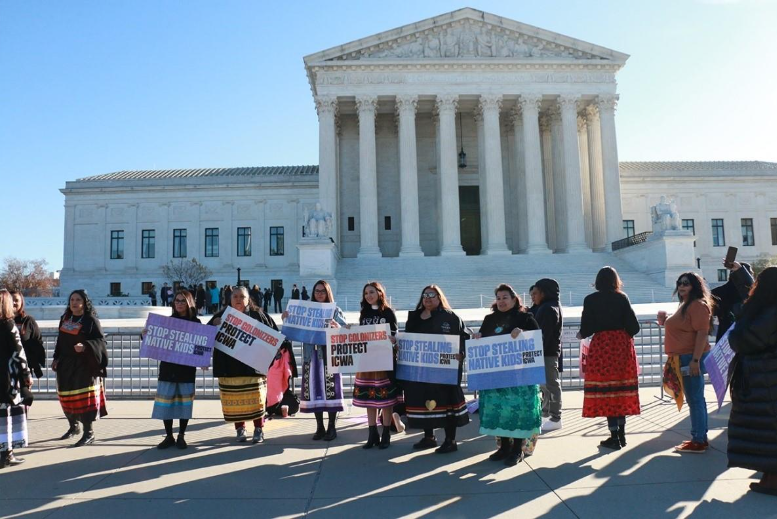
The most recent challenge to ICWA’s constitutionality on a national scale came in November of 2022, when the Supreme Court of the United States heard the oral arguments in Haaland v. Brackeen.
Facts: Chad and Jennifer Brackeen, a couple living in Texas, fostered a Native American child for a year before deciding to adopt. The child’s biological mother was a member of the Navajo nation, and their biological father was a member of the Cherokee Nation. While the biological parents and grandmother of the child were supportive of the adoption, the tribal nations opposed placement of the child with the Brackeen family. The Navajo Nation designated the child as a member and found an alternate placement with tribe members on a reservation in New Mexico, which would be given preference over the Brackeens under ICWA.
The Brackeens brought a lawsuit in Texas state court, claiming good reason to deviate from ICWA’s listed preferences. The case merged with two other child custody proceedings before making its way to the U.S. Supreme Court. The petitioners in this case argue that ICWA exceeds federal authority, infringes on states’ rights, and discriminates based on race.
Decision: The District Court granted a summary judgment, deciding in favor of the petitioners, which was partially upheld by the Fifth Circuit. The Fifth Circuit concluded that ICWA did not in fact exceed the authority of Congress or violate either the nondelegation doctrine or equal protection, however they were evenly divided on the question of whether ICWA discriminates based on race and violates the Tenth Amendment. The tie meant that the District Court’s decision was upheld.
On June 15th, 2023, the Supreme Court overturned this decision and ruled 7-2 in favor of the United States and the multiple tribal communities who advocated for the affirmation of ICWA. They argued that ICWA and the power of Congress to govern cases related to Native American affairs is protected by the Indian Commerce Clause; they also argued that the rights of states to govern in cases of domestic relations are not violated because the child has ties to a tribal nation, and the tribal nation has jurisdiction over the proceeding under ICWA.4
Significance: The Court’s decision is critical for the preservation of tribal sovereignty. The question of ICWA’s constitutionality is not a question of race-based discrimination or overreach of the federal government, but one of the right of tribal nations to govern themselves and decide what is best for their children. Overturning ICWA has potential to lead to a dangerous precedent that threatens things like land rights and the right of tribal governments to prosecute non-Native people on tribal lands. Framing the challenge to ICWA as a race-based argument is fundamentally wrong and ignores the political and cultural history of the relationship between the United States and Native American nations.
ICWA and Boarding Schools
The Indian Child Welfare Act has a deeply important relationship with boarding school history. The role of child abuse in the physical and cultural genocide perpetrated against Indigenous Americans cannot be understated.
Child removal, in addition to being incredibly harmful, is often not entirely justified in the cases of Indigenous children. The Western emphasis on the nuclear family does not align with the family structure of many Native communities and leads to the unnecessary removal of children from homes that are not actually unsafe or unhealthy. It is important to acknowledge that Indigenous people are far from a monolith and tribal nations operate differently, but many Indigenous children have parental relationships with relatives beyond just their biological parents. In the Navajo language, for example, there is no word directly translated to “aunt/uncle” or “niece/nephew.” Rather, the word for mother is shima’, and the word for aunt is shima’ ya’zhi’, which more closely translates to “little mother.” The word for “son” and “nephew” are similar, with an aunt addressing her nephew as shiazov (“little son” or “little child”).5 Often, entire Indigenous communities have child-rearing responsibilities, and this fact is not considered when children are removed from their homes for reasons like “parental neglect.”
“Certainly, the child-rearing traditions of indigenous peoples are as diverse as the communities that embody them.”
Lorie M. Graham, “The Past Never Vanishes: A Contextual Critique of the Existing Indian Family Doctrine”
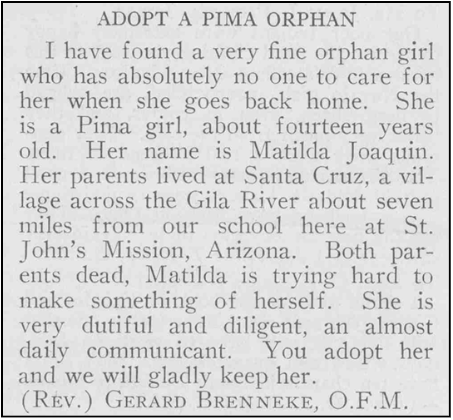
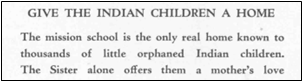
Adoption ads for Native children could be found in publications across the country, and often portrayed the escape from their own cultural systems as the only hope for Indigenous children. In particular, the Indian Sentinel, the official publication of the Society for the Preservation of the Faith among Indian Children within the Bureau of Catholic Indian Missions, features many sponsorship ads asking its readers to donate to residential schools. Readers would receive photos and handwritten letters from Native children in return for their donations. These depictions of schools as the saving grace for children’s were incredibly harmful and contributed to the breakdown of Native families and communities.




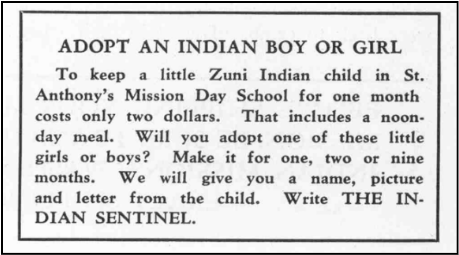

Removal also has disastrous consequences for the children’s health. Cross-racial adoption and being raised outside of one’s cultural system greatly increases the risk of identity crises and suicidal ideation. Native children are both overrepresented in the foster care system on the state and national level, and disproportionately affected by mental health issues. As of December 2023, they represent 2% of fostered children while representing only 1% of the total U.S. population, and 2% of the Wisconsin population but 9% of the children in out-of-home care.6 In addition, 25% of Indigenous children had considered attempting suicide, compared to 20% nationwide in 2023. Native children are also much more likely to have adverse childhood experiences (ACEs); 37% of Indigenous children have had 2 or more ACEs, while the national average is just 17%.7
The Indian Adoption Project
The Indian Adoption Project (IAP), established two decades before ICWA became law, was a joint initiative between the Bureau of Indian Affairs and the Child Welfare League of America with the goal of increasing adoptive placements of Indigenous children. The IAP aimed to save money for the government by both reducing reliance on the welfare and foster systems and reducing the cost of operating boarding schools, while still systematically assimilating Native children and eradicating Indigenous culture. In its 10 years of existence, the program placed almost 400 Native children, primarily from the West and Great Lakes region, into white adoptive homes located in the Northeast, mid-Atlantic, and Midwest. The IAP was influential in that it the number of Native children entering state welfare system increased dramatically, and state governments became more involved in cases involving Indigenous children. More and more Indigenous children were removed from their families in favor of white homes as state governments created standards for child-rearing without consideration of Native perspectives, and then took children away when Native parents didn’t meet those standards. It is estimated that in the 1960s and 1970s, one of every three Native children were removed from their home.8
The Existing Indian Family Doctrine
The Existing Indian Family exception (EIF) is a legal exception to ICWA adopted by several states through judicial decisions, including Kansas, Alabama, and Tennessee, though nearly as many have rejected the EIF in state courts or through legislation.9 States rejecting the EIF argue that not only does it perpetuate stereotypes and cause harm to children, but it also plainly ignores federal law and creates inconsistency in how ICWA is applied across state borders. The EIF generally invalidates ICWA’s application to a custody case when the child doesn’t have “sufficient” ties to a tribal nation, usually a cultural or emotional connection beyond blood relation. A court in California took it even further in 1996, when it was decided that ICWA does not apply if the biological parents of a Native child voluntarily give up custody and don’t maintain a significant cultural connection to a tribal nation. The court argued that in these cases that there is no good reason in these cases for disparate treatment between Native and non-Native children, and that applying ICWA would be race-based discrimination.10 Just like in the Brackeen case, this assessment ignores that the question of ICWA’s constitutionality is not one of race but political status of tribal nations. The EIF prevents ICWA from having its intended effect and puts many Indigenous children at risk.
Read the original text of the Indian Child Welfare Act of 1978 here.
Read the opinion of the Supreme Court on Haaland v Brackeen here.
- Molly Ivins, “Indians’ Tribal Courts Prepare to Take Over Child Custody Cases,” New York Times, December 25, 1978, https://www.proquest.com/docview/123542231/fulltextPDF/8276C44A61544DBDPQ/1?accountid=100&sourcetype=Historical%20Newspapers. ↩︎
- Ivins, “Tribal Courts.” ↩︎
- Congress.gov. “S.1214 – 95th Congress (1977-1978): Indian Child Welfare Act of 1978.” November 8, 1978. https://www.congress.gov/bill/95th-congress/senate-bill/1214.
↩︎ - Haaland v. Brackeen, 21–376, (2023) ↩︎
- Graham, Lorie M. “‘The Past Never Vanishes’: A Contextual Critique of the Existing Indian Family Doctrine.” American Indian Law Review 23, no. 1 (1998): 1–54. https://doi.org/10.2307/20068871 ↩︎
- “Native American Children’s Health and Well-Being,” Annie E. Casey Foundation, updated January 12, 2025, https://www.aecf.org/blog/native-childrens-health-and-well-being?msclkid=98443457c2741504020f5c3fcf4b6c34&utm_source=bing&utm_medium=cpc&utm_campaign=Blog%2025&utm_term=well%20being%20native%20american&utm_content=Native%20Children; “Wisconsin Out-of-Home Care (OHC) Report,” Child Welfare Reports and Dashboards, Wisconsin Department of Children and Families, 2023, https://dcf.wisconsin.gov/files/publications/pdf/5692.pdf ↩︎
- “Considering suicide,” Youth Risk Behavior Survey, Center for Disease Control and Prevention, 2023, https://yrbs-explorer.services.cdc.gov/#/graphs?questionCode=H27&topicCode=C01&location=XX&year=2023; Annie E. Casey Foundation, “Health and Well-Being.” ↩︎
- Margaret D. Jacobs. “Remembering the ‘Forgotten Child’: The American Indian Child Welfare Crisis of the 1960s and 1970s.” American Indian Quarterly 37, no. 1–2 (2013): 136–59. https://doi.org/10.5250/amerindiquar.37.1-2.0136. ↩︎
- Erler, Cassandra. “Excepted Out of Existence: The Existing Indian Family Exception as a Violation of Procedural Due Process and a Destructive Tool Against Tribal Communities.” The Journal of Gender, Social Policy & the Law (2020). https://jgspl.org/excepted-out-of-existence-the-existing-indian-family-exception-as-a-violation-of-procedural-due-process-and-a-destructive-tool-against-tribal-communities/. ↩︎
- Yablon, Marcia. “The Indian Child Welfare Act Amendments of 2003.” Family Law Quarterly 38, no. 3 (2004): 689–710. http://www.jstor.org/stable/25740482. ↩︎