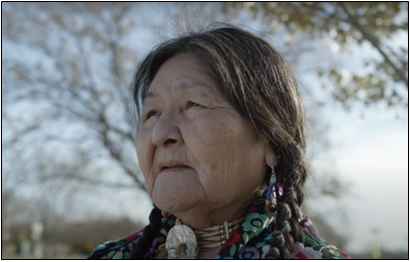
“When they’re teaching you to read, they’re having you repeat English words. If you couldn’t say the English words correctly, you were hit.”
Violet Catches, “Remember the Children”
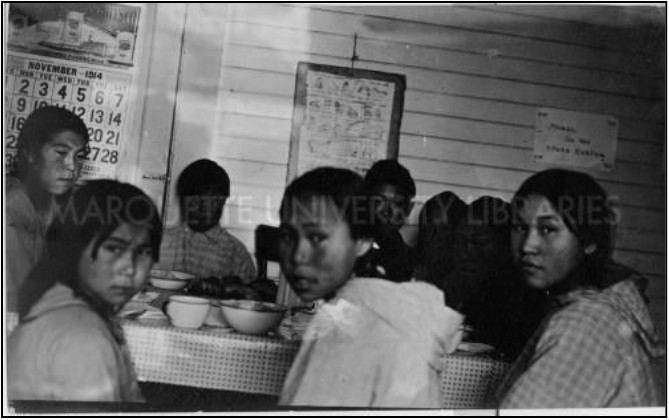
Native languages were very often banned from being spoken in boarding schools run by both the United States government and religious institutions. Different schools enforced these rules differently, but most utilized physical abuse as a means of keeping children obedient. This aspect of boarding school life caused trauma for many Native children, as it was one more barrier between children and their families. Students often left their homes for residential schools, sometimes not knowing any English, and returned with a much more limited ability to communicate with their relatives. This was also one reason that on- and off-reservation boarding schools were favored by assimilationists over on-reservation day schools. Long-term separation and minimal contact with a child’s family was considered more effective for English acquisition, and by extension the assimilation process.
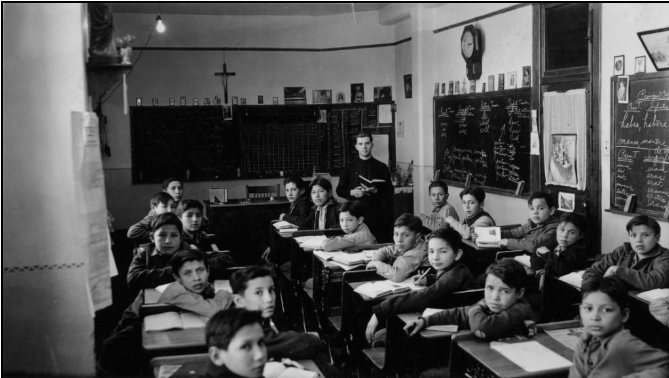
Speaking exclusively English at school was traumatic also because it was simply a very difficult task, especially given the fundamental differences between English and Native languages. A student whose first language was one of European origin might have an easier time recognizing patterns or similarities in words and structures between English and their first language. However, even given the diversity of Native languages, they differ from English foundationally. For example, there are some Native languages that can express complex ideas in a single word that would require an entire sentence to convey in English. Some Native languages place less emphasis on verb tense or parts of speech. Navajo languages reflect culture within grammar; to lose connection to that language brings with it an entire new worldview. Rules that required students to speak exclusively English forced them to completely rethink how they communicate and navigate their surroundings.1
Native Americans who could speak English were considered by white America to be superior to those who could not. Boarding schools took pride in the fact that their graduates were educated in all things but especially language, and therefore superior to those in their families and tribal communities who did not attend a residential school. Carlisle Indian Industrial School, for example, a government-run boarding school in Carlisle, Pennsylvania, boasted that their graduates were independent and were not “the old Indians with the long hair…[that] could speak no English and needed interpreters,” but rather the “only hope” for progress and civilization among Indigenous peoples.4 In the 1930 annual report from Pine Ridge Academy, a Catholic boarding school in South Dakota, it is stated that the outlook for Indigenous people who cannot speak English is “not promising.”5 These assertions demonstrate how critical these schools were to the assimilation process and the larger genocide carried out against Native people. Forbidding use of Native languages was one step in eradicating Native culture and achieving Richard Henry Pratt’s goal of “killing the Indian and saving the man.”
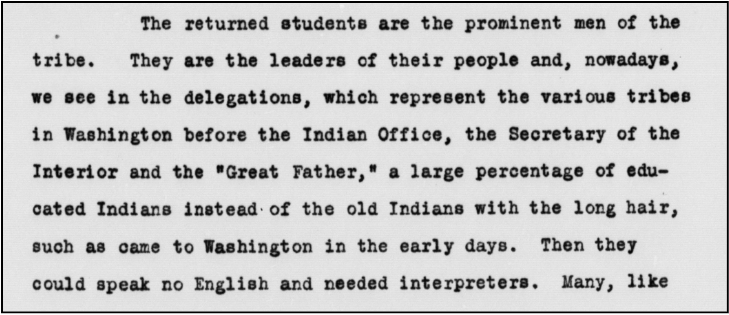

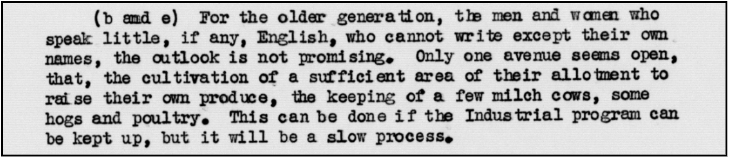
Excerpt from the Pine Ridge Academy Annual Report (1930).
Language Revitalization
After the government’s attempt to eradicate Indigenous culture, there have been many efforts put forth by both Indigenous and non-Indigenous activists to preserve Native languages. Due to the abusive nature of boarding schools and the widespread anti-Indigenous policy of the 19th and 20th centuries, many Native languages are in danger of disappearing. The extinction of Indigenous languages is dangerous and seriously threatens Native cultural transmission and identity, especially because many Native communities rely on oral communication rather than written to pass knowledge between generations.
Organizations like the National Indian Education Association and the National Congress of American Indians, for example, have advocated for federal and community action to protect Indigenous languages. The NIEA has created a space to post vacancies specifically for teaching positions in Native schools across the country, and this database allows schools to much more easily find and connect with educators who have language certifications. Initiatives of this kind are critical for providing students—youth and adults—with access to educational resources that are culturally appropriate and effective in cultural preservation. The NCAI supports similar efforts, calling for an end to English-only mandates and legislation that makes English the official language of the United States and especially pushing to “acknowledge and honor the important contributions that Native American languages have played in America’s history.”6
There have also been language revitalization efforts at the federal level. In 2024, the Biden-Harris Administration announced the 10-Year National Plan on Native Language Revitalization. The plan was a joint effort between Biden’s Department of the Interior (DOI), Department of Education (ED), and Department of Health and Human Services (HHS). This particular plan calls for Congressional support for Native languages in order to confront the role of the federal government in their disappearance. There are three main parts to this plan: expanding access to language immersion environments, support for community-led revitalization efforts, and growing Native language support networks. The Plan calls for an investment of approximately $16 billion in protection of Indigenous languages from the federal government between 2025 and 2035, after the US government put approximately $23 billion (adjusted for inflation) into the boarding school system and other assimilation policies in the 19th and 20th centuries. The U.S. government must recognize its “obligation to ensure that Native Nations continue to exist and flourish,” and language is a critical part of this obligation.7 The future of this initiative is uncertain with the change in administration in 2025 and the government shutdown.
Read the text of the 10-Year National Plan on Native Language Revitalization here.
- Adams, David Wallace. Education for Extinction: American Indians and the Boarding School Experience, 1875–1928. Second Edition, Revised and Expanded. University Press of Kansas, 2020. ↩︎
- Middle-level class with Jesuit teacher, 1939. 1939. Series 6-1. Bureau of Catholic Indian Missions Records. Department of Special Collections and University Archives, Marquette University, Milwaukee, WI, https://cdm16280.contentdm.oclc.org/digital/collection/p128701coll3/id/2072/rec/1. ↩︎
- Children in dining hall with sign, “Please, Do not speak Eskimo, 1914. 1914. Series 0. Bureau of Catholic Indian Missions digital image collection. Department of Special Collections and University Archives, Marquette University, Milwaukee, WI. ↩︎
- Department of the Interior. Office of Indian Affairs. Office of the Finance Officer. Statistics Section. 2/1934-1939, “Captian Grande School Carlisle School: 1910-11; Capitan Grande School Carlisle School: 1910-17; Carson; School: 1910-26,” n.d., National Archives at Washington, DC – Textual Reference, accessed July 26, 2025, https://catalog.archives.gov/id/155856439?objectPage=1015. ↩︎
- Department of the Interior. Office of Indian Affairs. Office of the Finance Officer. Statistics Section. 2/1934-1939, “Pine Ridge: 1930-35; Pipestone School: 1910-31,” n.d., National Archives at Washington, DC – Textual Reference, accessed August 2, 2025, https://catalog.archives.gov/id/155970094?objectPage=58. ↩︎
- “NCAI Protection of Native Languages,” National Council of American Indians, accessed October 16, 2025, https://ncai.org/news/ncai-protection-of-native-languages. ↩︎
- White House Council on Native American Affairs, Committee on Education, 10-Year Plan on Native Language Revitalization. 2024, https://www.bia.gov/sites/default/files/media_document/final_12032024_10-year_national_plan_on_native_language_revitalization.508_1.pdf. ↩︎